Case study / Irish Sea entrance
Fastnet
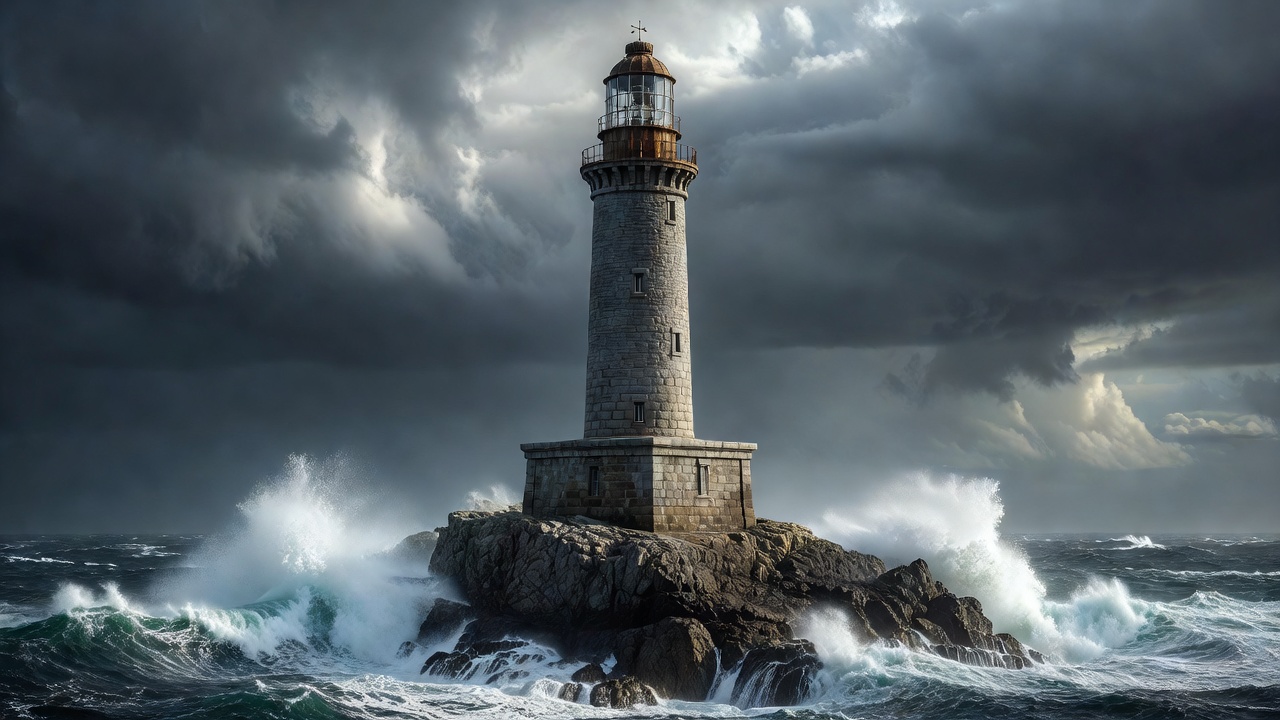
Why is Fastnet significant?
Fastnet Rock stands in the Atlantic south-west of Ireland and marks a demanding approach to the Irish coast. The station is associated with the Commissioners of Irish Lights, the body responsible for aids to navigation around Ireland. Its position makes the tower a reference point as well as a warning against the rock itself.
What changed between towers?
An earlier cast-iron tower occupied the rock before the present masonry lighthouse. The later tower used granite and a more substantial form suited to heavy Atlantic exposure. Replacement was not a matter of making a familiar shape taller. The foundation, wall thickness, joints, lantern and access all had to be reconsidered as one system.
How does the masonry resist the sea?
The tower broadens towards its base and narrows through the shaft. Large granite blocks provide mass, while shaped joints limit movement between courses. The curved face avoids a sharp corner for wave impact. These measures do not make the sea harmless; they make repeated loading less destructive to the structure.
What is the optical question?
Fastnet’s value depends on recognition. A mariner needs a light that can be distinguished from shore lights, vessels and background illumination. The character is therefore documented through timing and visibility. Fresnel optics concentrate the source, while a rotating or otherwise controlled apparatus determines the sequence seen at distance.
How does Fastnet compare with Eddystone?
Both are offshore masonry towers with long histories of redesign. Eddystone’s story is especially marked by successive experiments and replacement. Fastnet is a later expression of the same broad engineering logic: a heavy, tapered stone tower on a difficult rock, managed within a national navigation system.
What did automation change?
Automation reduced the need for permanent resident keepers and moved attention towards remote monitoring, power supply, access and planned maintenance. It did not remove the station’s obligations. The light must still show the published character, equipment must be serviced and the tower must remain part of coherent navigational information.