Case study / exposed reef
Eddystone
Why was Eddystone difficult?
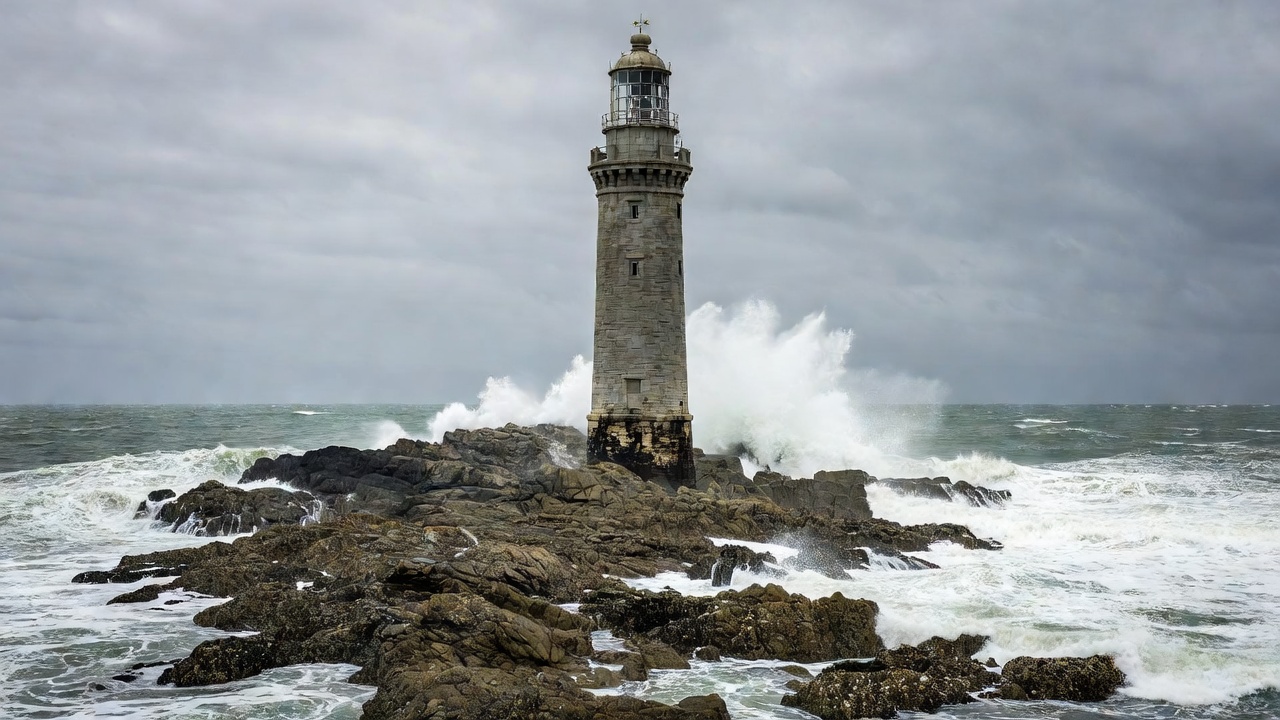
The Eddystone Rocks lie south-west of Plymouth, beyond the protection of the mainland. The problem was not simply height. A useful tower needed a foundation on uneven, wave-washed rock, enough mass to resist overturning and an optical apparatus visible to shipping. Every material had to arrive by sea, and work windows depended on tide and weather.
What did the early towers prove?
Henry Winstanley’s first lighthouse, built at the end of the seventeenth century, used a timber structure. A later version increased the scale but was destroyed with its occupants in a severe storm. John Rudyerd’s replacement used timber again and lasted longer. These buildings established the value of a permanent light while exposing the limits of combustible materials and less integrated foundations.
Why is Smeaton’s tower important?
John Smeaton’s lighthouse, completed in the eighteenth century, used granite blocks joined with dovetail joints and hydraulic lime. Its curved profile widened towards the base and narrowed upwards. The geometry lowered the centre of gravity and presented a more controlled surface to waves. Smeaton also treated the tower as a single connected mass rather than a stack of ordinary masonry.
What happened to the old tower?
The rock beneath Smeaton’s tower was later judged unsuitable for the greater height and power required by changing navigation practice. The upper part was dismantled and rebuilt on Plymouth Hoe as a memorial. The original base remains on the reef, while James Douglass designed the replacement tower, completed in the late nineteenth century, using improved construction methods and a more powerful light.
How did the optics alter the signal?
A lighthouse is identified by more than brightness. Its flash pattern, colour and interval form a characteristic. Eddystone’s apparatus changed as oil, Fresnel lenses, electric light and later automation became available. The lens concentrates light into useful beams; rotation or occulting produces the rhythm recorded in sailing directions. The tower therefore combines civil engineering with a visual code.
What should a reader compare?
Compare Eddystone with Bell Rock by foundation conditions and with Fastnet by exposure. Eddystone shows repeated redesign after failure and replacement. It also shows why a lighthouse is an institutional object: Trinity House had to fund, maintain and communicate the aid to navigation, while engineers translated each failure into a new structural decision.