Case study / tidal reef
Bell Rock
What is the Bell Rock problem?
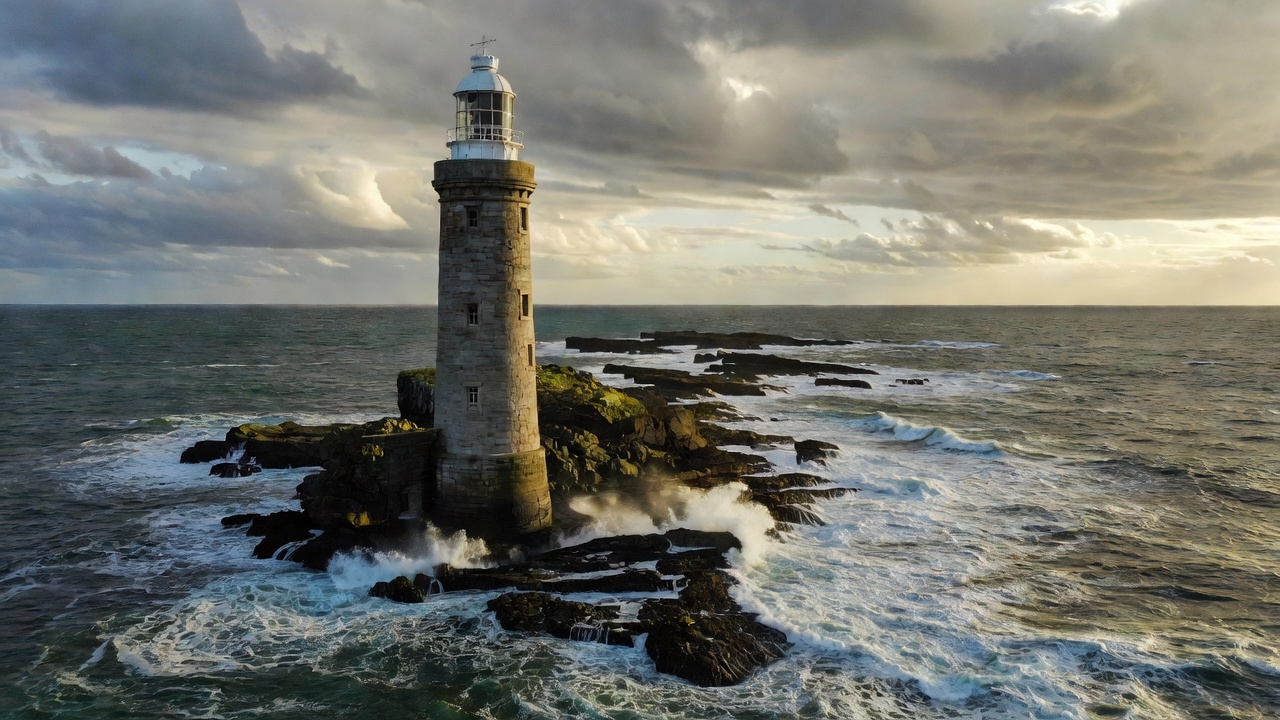
Bell Rock, off the Angus coast, is submerged for part of the tidal cycle. That made surveying, landing materials and setting masonry unusually demanding. Robert Stevenson’s design had to occupy a narrow reef while allowing workers to leave before the sea covered the working surface.
How does the foundation work?
The tower uses carefully shaped stone courses that interlock around the rock. The lower masonry follows the irregular foundation, while the upper profile becomes smoother and more regular. Dovetailing and keyed joints resist sliding between courses. The weight of the tower matters, but the connection to the reef matters first.
Why is the profile familiar?
The broad base and curved batter reduce abrupt changes in the face exposed to waves. The tower becomes narrower as it rises, keeping mass low and limiting the leverage of wind. Granite was selected for durability and dressed into blocks that could be fitted with precision rather than treated as rough rubble.
What role did the Northern Lighthouse Board play?
The Northern Lighthouse Board was responsible for Scotland’s coastal lights. Its work joined local navigation needs to engineering, procurement and maintenance. Bell Rock demonstrates the Board’s practical tradition: establish the hazard, measure the site, design for the working season and preserve a dependable character for mariners.
How should Bell Rock be compared with Eddystone?
Both towers solve offshore foundation problems through mass, geometry and interlocking masonry. Bell Rock’s tidal exposure creates a particularly strict work rhythm. Eddystone’s history includes several replacement towers and a more open Atlantic position. Bell Rock is also a clearer example of one coherent masonry scheme surviving at its original site.
What does the light communicate?
The lantern and optical equipment convert a fixed tower into a signal. A characteristic is recorded by flashes and eclipses, not by appearance alone. The apparatus has changed over time, but the principle remains: a navigator identifies the station through a repeatable light pattern and checks it against charts and sailing directions.